


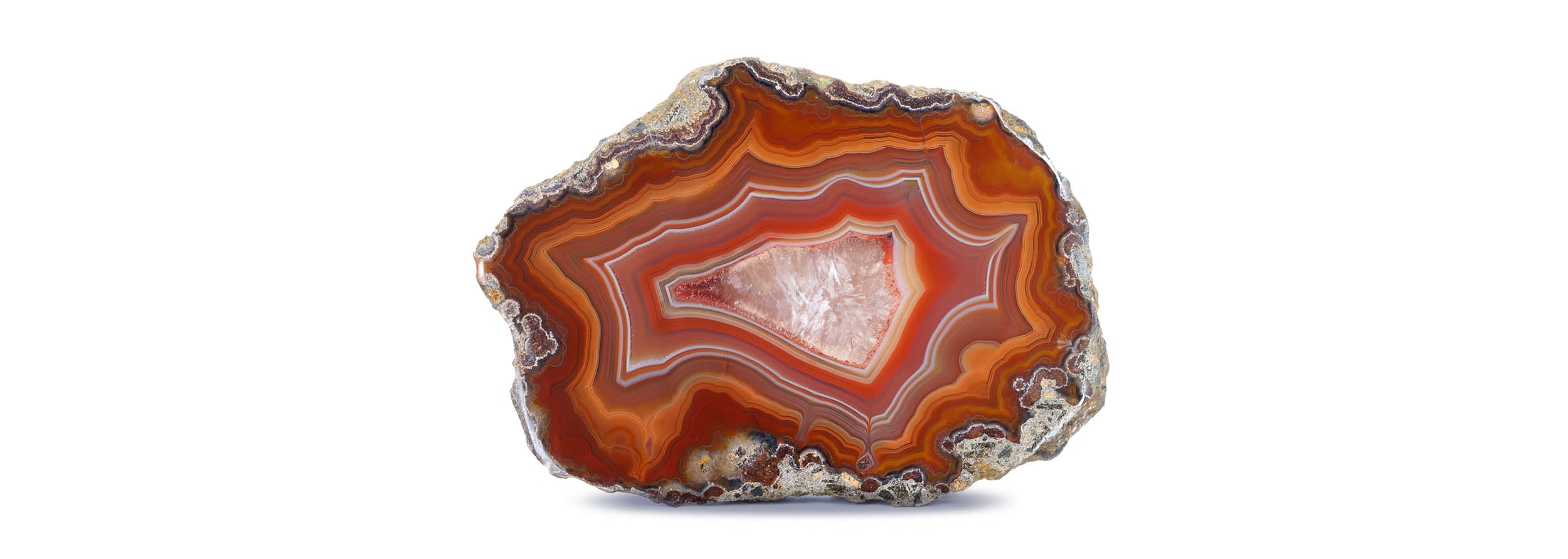
No two pieces of Agate tell quite the same visual story. Its natural bands, layers and changing colours have made it a fitting symbol of balance, resilience and individuality — different layers coming together to form something stronger as a whole.
Connected with the Root Chakra, Agate is believed to encourage grounding, stability and confidence, particularly when life feels unsettled. Its steady character is associated with calming emotional tension and helping the wearer approach difficult situations without becoming overwhelmed.
Rather than representing sudden bursts of power, Agate reflects quiet, dependable strength — patience, composure and the resilience to keep moving forward one step at a time.
Associated with: Strength • Stability • Courage • Grounding • Confidence • Balance • Resilience • Calm
Care: Agate is relatively durable and easy to maintain. Clean gently with lukewarm water, mild soap and a soft cloth. Avoid harsh chemicals, prolonged high heat and strong impacts.
* These meanings are based on traditional and metaphysical beliefs.
Agate is a Semi-Precious Gemstone
Agate is a semi-precious gemstone and a variety of Chalcedony, a microcrystalline form of Quartz composed mainly of Silicon Dioxide (SiO₂). It is best known for its distinctive bands, layers and natural patterns, which can appear in many different colours.
Agate often forms inside cavities of volcanic rocks, where silica-rich fluids gradually deposit layer upon layer over long periods of time. These natural layers create the unique banding and patterns that make each piece different.
With a hardness of around 6.5–7 on the Mohs scale, Agate is durable and well suited for everyday jewellery.
Important deposits are found in Brazil, Uruguay, Mexico, India, Madagascar and the United States, with different regions producing their own distinctive colours and patterns.
Mohs Hardness: 6.5–7
Mineral Family: Quartz / Chalcedony
Composition: Silicon Dioxide — SiO₂
Transparency: Translucent to opaque
Lustre: Waxy to vitreous when polished
Colours: White, grey, brown, red, orange, yellow, blue, green, black and multicoloured varieties
Distinctive Feature: Natural banding, layers and highly individual patterns
Major Sources: Brazil, Uruguay, Mexico, India, Madagascar and the United States