


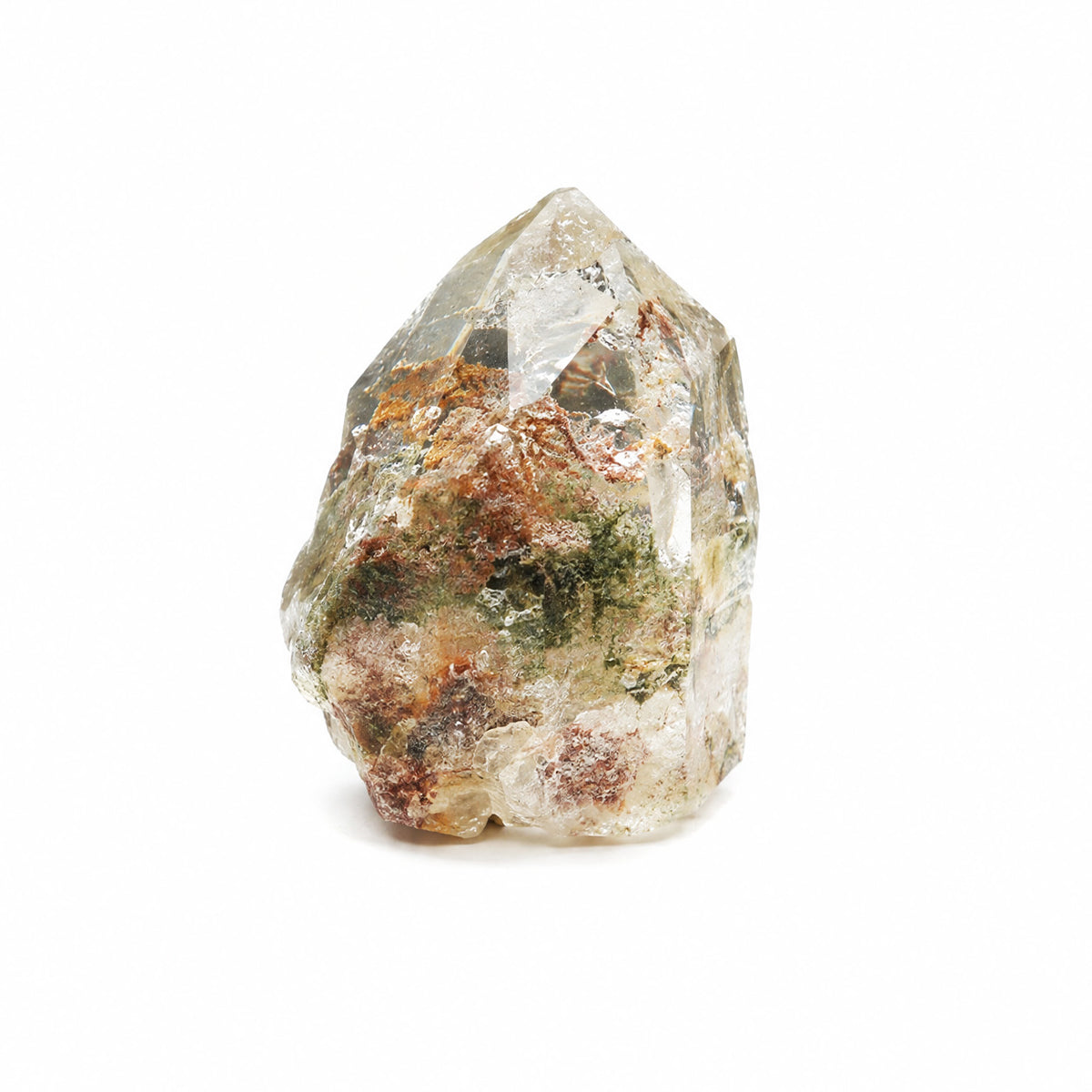
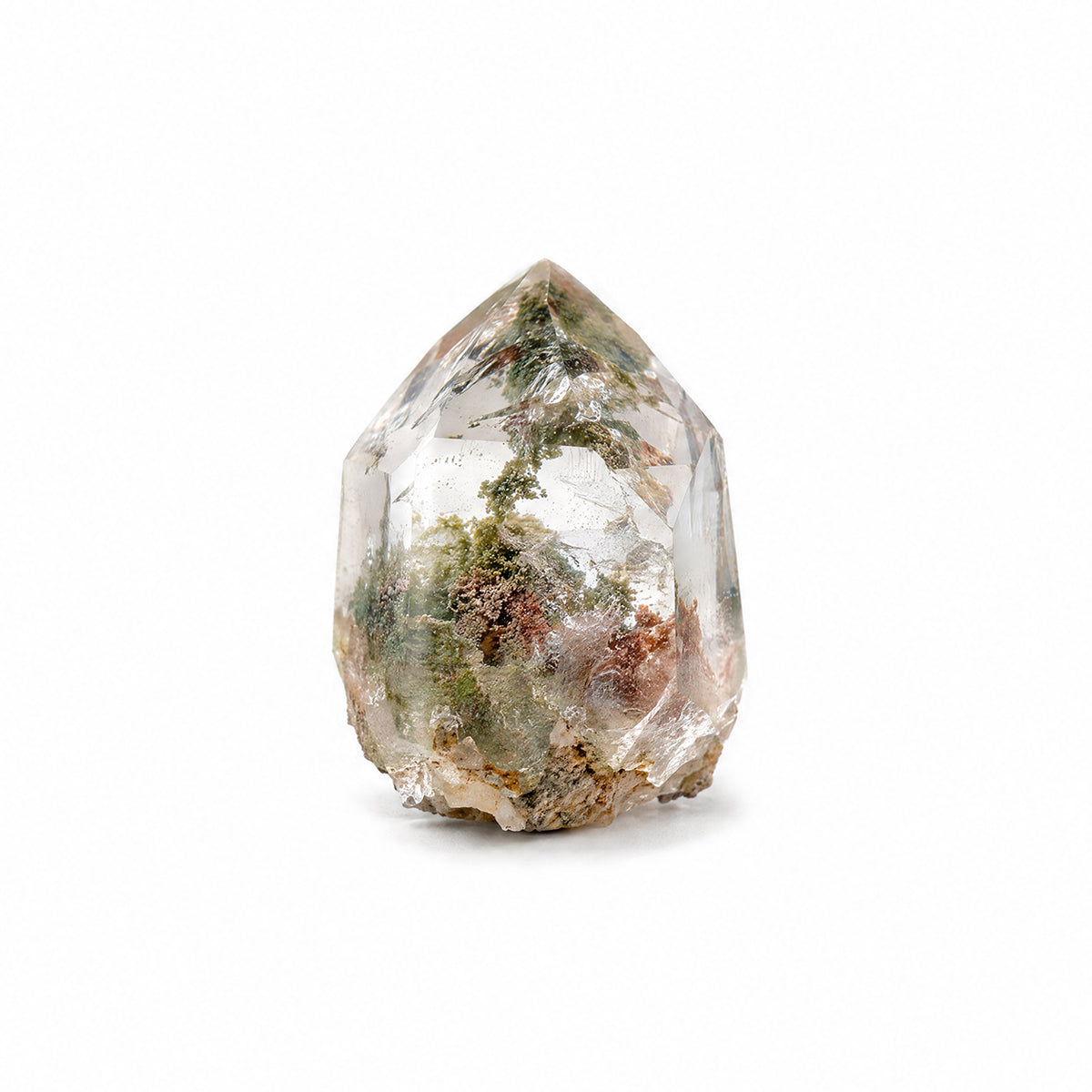
Garden Quartz, also known as Lodolite or Scenic Quartz, is a captivating variety of inclusion-bearing natural Quartz, admired for its extraordinary internal formations that resemble miniature gardens, forests, mountains and landscapes suspended within the crystal.
These intricate formations are created by naturally occurring mineral inclusions, commonly including Chlorite, Hematite and other iron-bearing minerals. As Quartz develops within the Earth's geological environment, mineral particles may become enclosed during crystal growth, preserving remarkable patterns of colour, texture and depth.
Unlike gemstones celebrated primarily for their colour or transparency, Garden Quartz is distinguished by the extraordinary scenery contained within it. Shades of moss green, earthy brown, reddish orange, cream and grey create organic compositions reminiscent of distant mountain ranges, flourishing forests or landscapes viewed from above.
Every specimen presents a different arrangement of inclusions, making each stone a unique expression of the Earth's natural artistry. Some reveal delicate, cloud-like formations, while others display dramatic mineral landscapes that appear almost three-dimensional.
Garden Quartz is often confused with Phantom Quartz, although the distinction lies in their internal formations. While Phantom Quartz preserves recognisable outlines of earlier crystal growth, Garden Quartz is characterised by scenic mineral inclusions that do not necessarily follow the shape of a growing crystal.
Belonging to the Quartz family, Garden Quartz has a hardness of approximately 7 on the Mohs scale, making it relatively durable and suitable for jewellery. However, specimens containing natural fractures or extensive inclusions should be handled with additional care.
Garden Quartz is a Semi-Precious Stone.
Gemstone Name: Garden Quartz
Alternative Trade Names: Lodolite, Scenic Quartz, Landscape Quartz
Birthstone: Not an official monthly birthstone
Mohs Hardness: 7
Mineral Family: Quartz
Mineral Classification: Silicate Mineral
Chemical Composition: Silicon Dioxide (SiO₂), with variable mineral inclusions
Crystal System: Trigonal
Transparency: Transparent to translucent, with potentially opaque inclusions
Lustre: Vitreous
Refractive Index: Approximately 1.544–1.553
Specific Gravity: Approximately 2.65, potentially variable with inclusions
Typical Colours: Clear Quartz containing green, brown, red, orange, cream, grey or black inclusions
Common Inclusions: Chlorite, Hematite, other iron oxides and various mineral deposits
Distinctive Characteristics: Scenic inclusions resembling gardens, forests, mountains and miniature landscapes
Notable Sources: Brazil and Madagascar, among other Quartz-producing regions
Symbolism: Personal Growth • Harmony • Resilience • Transformation • Renewal • Stability • Connection with Nature
Symbolism & Traditional Meanings
Garden Quartz is commonly associated with personal growth, harmony, resilience, renewal and a deep connection with nature.
Its remarkable internal landscapes symbolise the richness of life's experiences, where different layers, challenges and transformations contribute to a greater whole.
In contemporary Chinese crystal culture, scenic Quartz formations are sometimes interpreted as representations of mountains, flourishing landscapes and natural abundance. These visual associations may symbolise stability, prosperity, steady progress and the importance of remaining grounded while pursuing life's ambitions.
Beyond material success, Garden Quartz carries a more universal meaning: the beauty of transformation, patience and embracing one's individual journey.
Just as no two natural landscapes are identical, every Garden Quartz gemstone reflects a unique story shaped by time and geological change.
For VARDE®, Garden Quartz represents a simple yet meaningful philosophy:
True beauty lies not in perfection, but in the extraordinary journey of becoming.