



Named after one of the world’s most formidable mountains, K2 naturally carries a sense of challenge, exploration and reaching beyond familiar limits. Its striking contrast of pale stone and vivid blue makes it a fitting symbol of staying grounded while continuing to aim higher.
Closely associated with the Third Eye and Crown Chakras, K2 is believed to encourage intuition, awareness and broader perspective. At the same time, its grounding character reflects practical thinking and stability.
For those entering new territory, K2 symbolises the courage to explore possibilities without losing sight of where they stand.
It is a stone of perspective and discovery — grounded enough to remain steady, ambitious enough to keep climbing.
Associated with: Grounding • Insight • Adventure • Wisdom • Awareness • Growth • Perspective • New Beginnings
Care: K2 should be handled with care because its different mineral components have varying hardness. Clean gently with a soft, slightly damp cloth and avoid prolonged soaking, harsh chemicals, acids, high heat, steam and ultrasonic cleaners.
* These meanings are based on traditional and metaphysical beliefs.
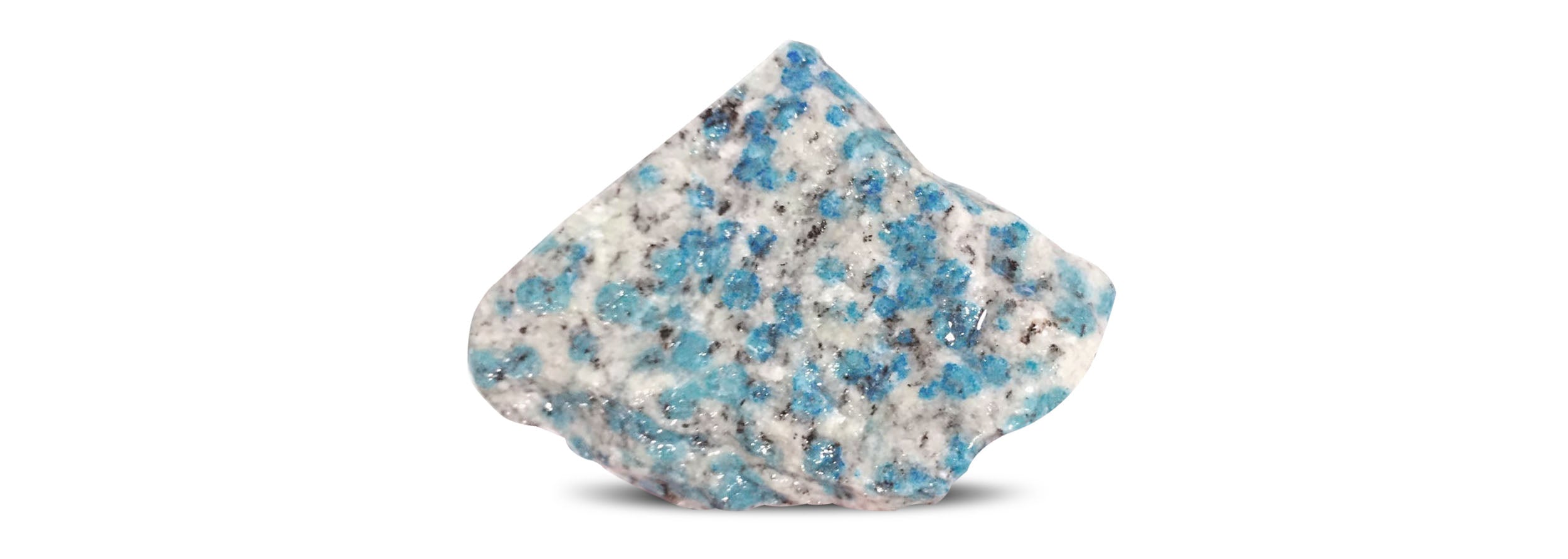
K2 is a Decorative Rock
K2, commonly known as K2 Jasper, is actually a pale granite containing distinctive blue Azurite inclusions. Despite its commercial name, it is not a true Jasper. It is found in the Karakoram region of Pakistan, near K2, the world’s second-highest mountain.
Its pale granite is composed mainly of minerals such as feldspar, quartz and biotite, while the vivid blue Azurite creates the characteristic spotted appearance that makes K2 so recognisable.
Because K2 contains several different minerals, it does not have one uniform Mohs hardness. The granite portion is generally around 6–7, while the softer Azurite inclusions measure approximately 3.5–4, meaning the blue areas require additional care.
Its unusual combination of rugged granite and vivid blue mineral inclusions has made K2 a distinctive material for jewellery, beads, cabochons and decorative pieces.
Mohs Hardness: Approx. 6–7 (Granite); 3.5–4 (Azurite)
Rock Type: Granite with Azurite inclusions
Main Components: Feldspar, Quartz, Biotite and Azurite
Transparency: Opaque
Lustre: Dull to vitreous when polished
Colours: Cream, white and grey with vivid blue spots
Distinctive Feature: Natural blue Azurite inclusions within pale granite
Primary Origin: Karakoram Region, Pakistan