



Some stones feel connected with stability; Kyanite carries more of a sense of possibility. It is often associated with new directions, opportunities and the confidence to step into unfamiliar territory.
Closely associated with the Throat Chakra, Kyanite is believed to encourage clear communication, self-expression and emotional balance. It is often chosen when important conversations, decisions or changes require a calmer and more focused state of mind.
Kyanite is also connected with reflection and personal growth. Looking back is not always about dwelling on the past — sometimes it helps us understand what worked, what did not and where to go next.
In crystal traditions, Kyanite is also said to disperse rather than retain negative energy, which is why it is sometimes believed to require little energetic cleansing.
Associated with: Opportunity • Growth • Communication • Clarity • Balance • Confidence • Reflection • New Beginnings
Care: Kyanite has variable hardness depending on crystal direction and can be relatively brittle. Clean gently with lukewarm water, mild soap and a soft cloth. Avoid hard knocks, harsh chemicals, high heat, steam and ultrasonic cleaners.
* These meanings are based on traditional and metaphysical beliefs.
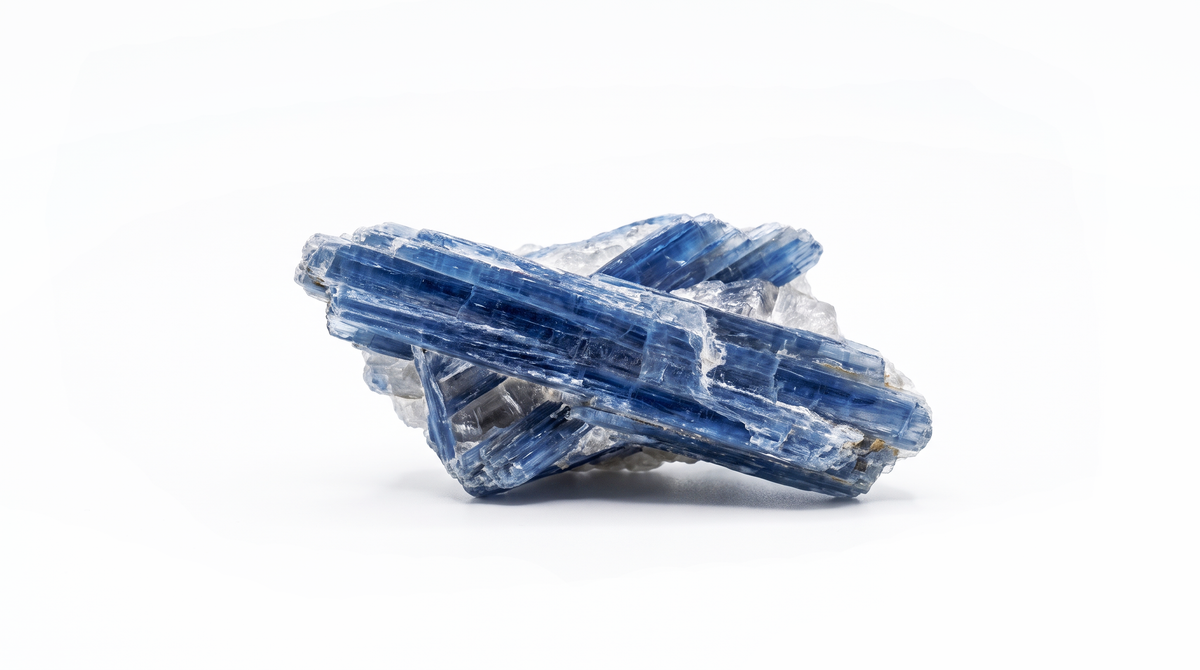
Kyanite is a Semi-Precious Gemstone
Kyanite is a semi-precious gemstone and an aluminium silicate mineral with the chemical formula Al₂SiO₅. It is best known for its rich blue colour, although it can also occur in green, black, orange, white and grey. The name comes from the Greek word kyanos, meaning “deep blue.”
One of Kyanite’s most unusual characteristics is its variable hardness. It measures about 4.5–5 along the length of the crystal and approximately 6.5–7 across it, meaning its hardness changes depending on direction.
Kyanite commonly forms in metamorphic rocks under high-pressure conditions and is valued for its elongated, blade-like crystal structure, vivid colour and pearly to glassy lustre.
Blue Kyanite is especially popular in jewellery and mineral collections for its distinctive natural appearance and strong colour.
Mohs Hardness: 4.5–5 lengthwise; 6.5–7 across
Mineral Family: Silicate Mineral
Composition: Aluminium Silicate (Al₂SiO₅)
Transparency: Transparent to translucent
Lustre: Vitreous to pearly
Colours: Blue, green, black, orange, white and grey
Distinctive Feature: Direction-dependent hardness and blade-like crystal structure
Major Sources: Brazil, United States, Austria, Australia, Italy, Myanmar, Switzerland.