



Often called the Tempest Stone, Pietersite looks almost like a storm frozen in time — waves of blue, gold, brown and darkness twisting through one another. That restless appearance has made it a powerful symbol of transformation, courage and moving through uncertainty.
Connected with the Third Eye and Solar Plexus Chakras, Pietersite is believed to encourage intuition, confidence and clearer perspective, especially when circumstances feel chaotic or unpredictable.
Rather than representing the absence of difficulty, Pietersite represents the ability to move through the storm without losing direction. It is associated with breaking old patterns, adapting to change and recognising new possibilities when the path ahead is unclear.
Associated with: Transformation • Courage • Clarity • Confidence • Intuition • Adaptability • Growth • Perspective
Care: Pietersite is relatively durable but should be protected from hard impacts and harsh chemicals. Clean gently with lukewarm water, mild soap and a soft cloth. Avoid excessive heat, steam and ultrasonic cleaners.
* These meanings are based on traditional and metaphysical beliefs.
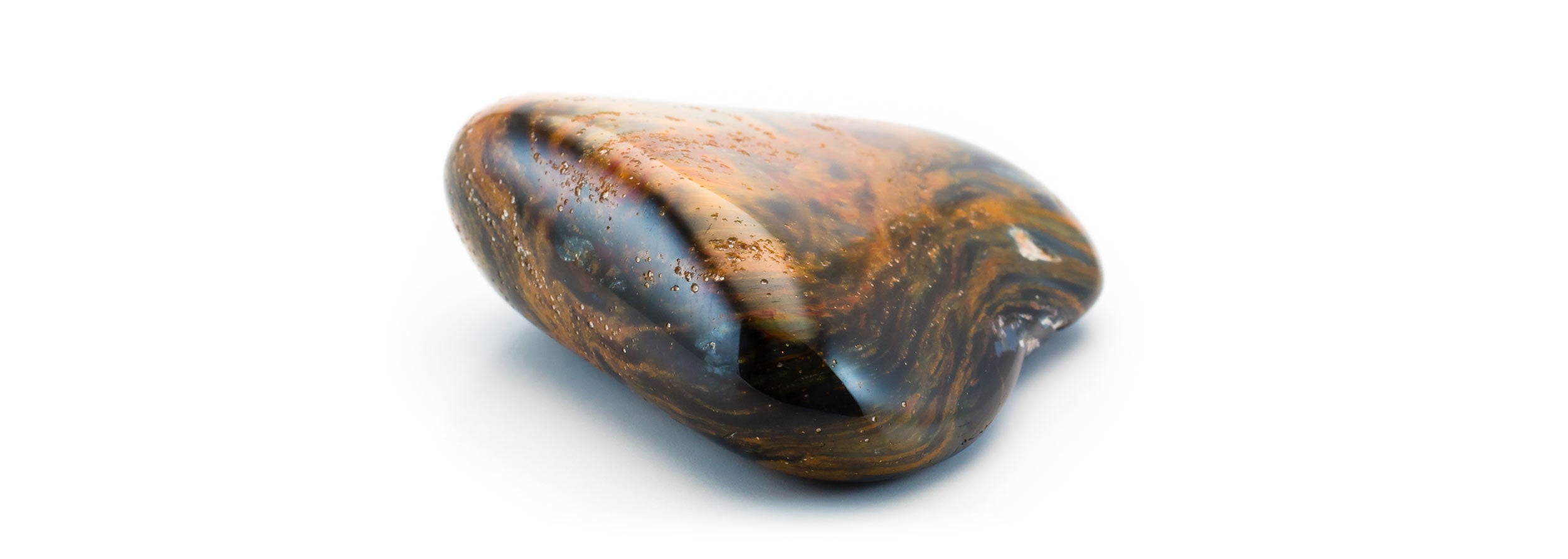
Pietersite is a Semi-Precious Gemstone
Pietersite is a semi-precious gemstone and a brecciated variety of chalcedony, composed mainly of silicon dioxide (SiO₂) with fibrous amphibole inclusions that create its dramatic chatoyant effect.
It is best known for its swirling mixtures of blue, gold, brown, red and black, often resembling a storm trapped within the stone. Its highly individual patterning gives each piece a distinctive natural character.
First discovered in Namibia in 1962, Pietersite is also found in China, with colour and pattern variations differing between sources.
With a hardness of approximately 6.5–7 on the Mohs scale, Pietersite is reasonably durable and suitable for jewellery.
Mohs Hardness: 6.5–7
Mineral Family: Quartz / Chalcedony
Composition: Silicon Dioxide (SiO₂) with fibrous amphibole inclusions
Transparency: Opaque
Lustre: Silky to vitreous
Colours: Blue, gold, brown, red and black
Distinctive Feature: Strong chatoyancy with swirling, storm-like patterns
Major Sources: Namibia and China