



Stay calm. Think clearly. That simple idea captures much of Sodalite’s character. Its rich blue appearance has long made it a natural symbol of logic, truth, clarity and inner peace.
Closely associated with the Throat Chakra and Third Eye Chakra, Sodalite is believed to support clear thinking, honest communication and better judgement. It is often linked with situations where emotions and logic need to work together rather than pull in opposite directions.
Its blue colour also connects strongly with the Water element in Feng Shui, symbolising calm, flow and the ability to cool heated emotions. In relationships and Guanxi, Sodalite is associated with trust, goodwill and smoother communication.
Associated with: Truth • Logic • Clarity • Peace • Communication • Trust • Balance • Goodwill
Care: Sodalite should be handled with reasonable care. Clean gently with lukewarm water, mild soap and a soft cloth. Avoid harsh chemicals, acids, prolonged soaking, high heat, steam and ultrasonic cleaners.
* These meanings are based on traditional and metaphysical beliefs.
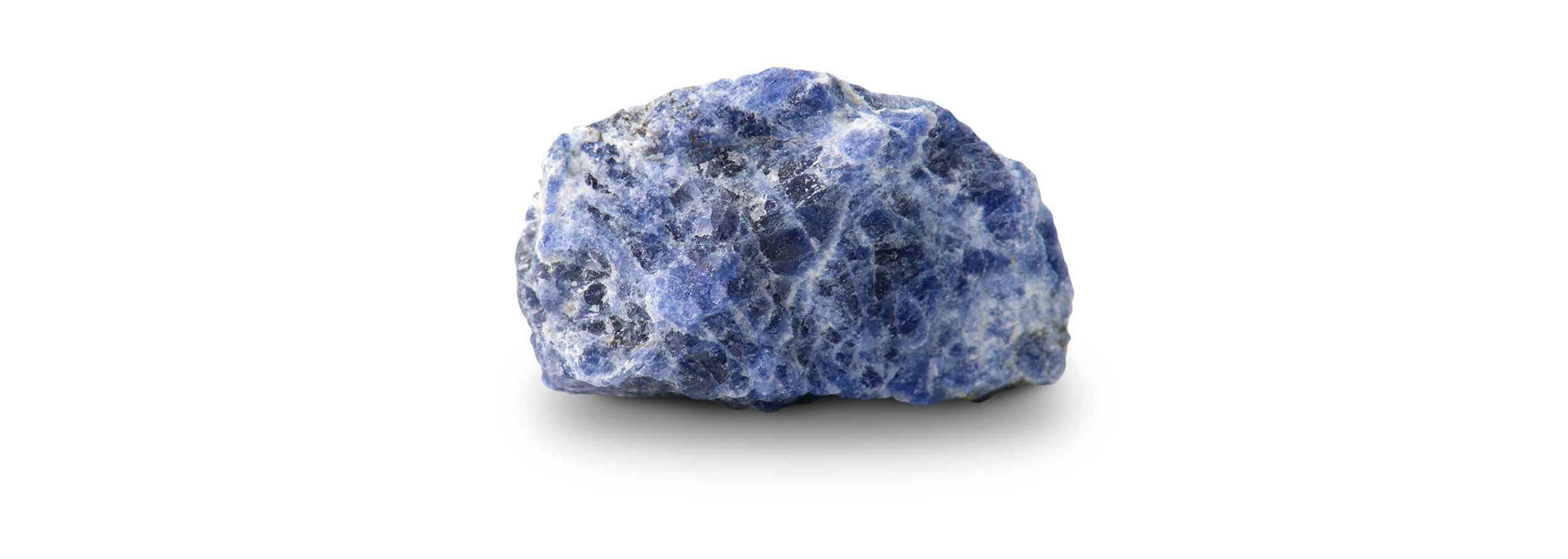
Sodalite is a Semi-Precious Gemstone
Sodalite is a semi-precious gemstone and a sodium aluminium silicate mineral, best known for its rich royal blue to deep blue colour, often crossed by natural white veins of Calcite.
It was first discovered in Greenland in 1811, but became widely appreciated as an ornamental stone after significant deposits were found in Canada. Its name comes from its relatively high sodium content.
Sodalite is sometimes mistaken for Lapis Lazuli because of its similar blue colour. However, Sodalite generally lacks the golden Pyrite flecks commonly seen in Lapis Lazuli and often shows more obvious white veining.
With a hardness of around 5.5–6 on the Mohs scale, Sodalite is suitable for beads, carvings and jewellery when handled with reasonable care.
Mohs Hardness: 5.5–6
Mineral Family: Feldspathoid / Silicate Mineral
Composition: Sodium Aluminium Silicate with Chloride — Na₈(Al₆Si₆O₂₄)Cl₂
Transparency: Translucent to opaque
Lustre: Vitreous to greasy
Colours: Royal blue, deep blue, blue-violet, grey and white
Distinctive Feature: Rich blue colour commonly patterned with natural white Calcite veining
Major Sources: Canada, Brazil, Namibia, Russia and Greenland