


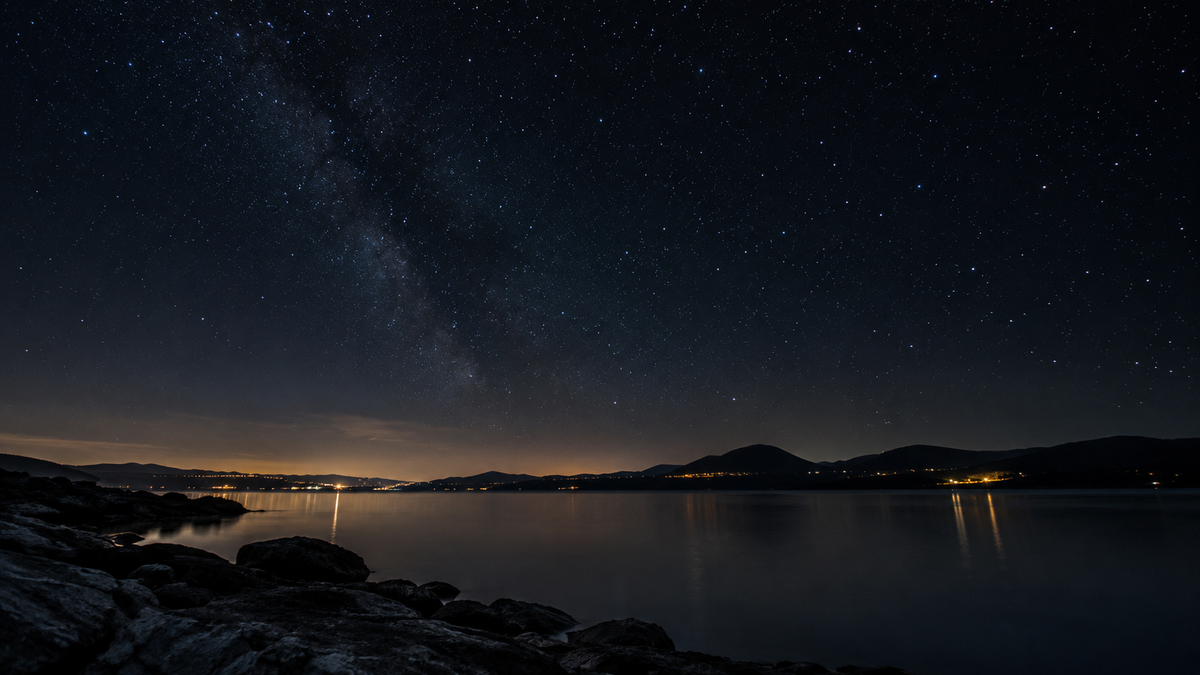
Sometimes the most beautiful night-sky event is the one you cannot actually see.
On 10 October 2026, the Moon enters its New Moon phase. From Earth, its illuminated side faces away from us, leaving the Moon almost completely hidden from view. In Singapore, the exact New Moon occurs at 11:50 PM.
But the real attraction of a New Moon is not the Moon itself.
It is the darkness it leaves behind.
When the Moon Steps Aside
Moonlight can be surprisingly bright. Around a Full Moon, its glow washes out many of the fainter stars that would otherwise be visible.
Near New Moon, that interference disappears.
The sky becomes darker, faint stars become easier to notice, and constellations can appear more defined. For anyone interested in stargazing or night-sky photography, the nights surrounding a New Moon are often some of the most rewarding of the month.
You do not need to observe at exactly 11:50 PM. The entire evening of 10 October and the night into 11 October will have extremely little moonlight. In Singapore, the Moon is only about 0.3% illuminated on 10 October and about 0.5% on 11 October.
New Moon Around the World
The New Moon occurs at the same astronomical moment everywhere, but local dates and clock times differ.
| Location | New Moon — Local Time |
|---|---|
| 🇸🇬 Singapore | 10 Oct · 11:50 PM |
| 🇦🇺 Sydney | 11 Oct · 2:50 AM |
| 🇮🇳 New Delhi | 10 Oct · 9:20 PM |
| 🇬🇧 London | 10 Oct · 4:50 PM |
| 🇺🇸 New York | 10 Oct · 11:50 AM |
| 🇺🇸 Los Angeles | 10 Oct · 8:50 AM |
New Delhi's local phase time is independently listed as 9:20 PM on 10 October, consistent with the same global New Moon event.
From Singapore
For Singapore, the challenge is not the Moon — it is city light.
You do not necessarily need complete wilderness, but the farther you can get from strong buildings, floodlights and brightly illuminated roads, the more your eyes can adjust to the sky.
Give yourself around 20 minutes away from bright screens and artificial lighting. Look upward rather than toward the illuminated horizon, and allow time for faint stars to gradually appear.
On 10 October, the almost-dark Moon sets at approximately 6:34 PM, and on 11 October the extremely thin young Moon sets around 7:19 PM.
After that, the night belongs almost entirely to the stars.
What Darkness Reveals
A New Moon is an unusual celestial event because its beauty comes from absence.
There is no brilliant Moon demanding your attention. No dramatic eclipse. No glowing planet dominating the sky.
Instead, one familiar light quietly disappears — and countless smaller ones become easier to notice.
Perhaps that is why dark skies can feel so different.
Sometimes we see more not because something brighter appears, but because something bright finally steps aside.
Less light. More sky.
Share:
12 October 2026 — Mercury at Greatest Eastern Elongation
21–22 October 2026 — Orionid Meteor Shower