


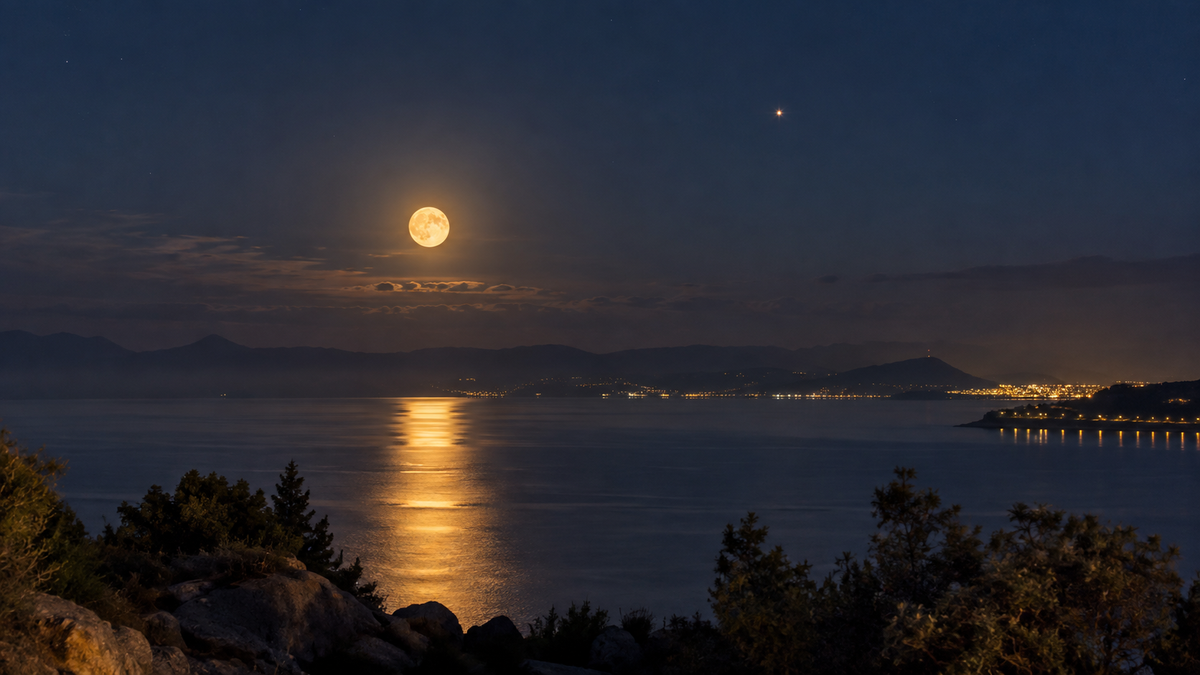
For one night in late September, the Full Harvest Moon and Saturn will share the same part of the sky, creating an easy celestial pairing that requires no special equipment to enjoy.
September’s Full Moon reaches peak illumination at 16:49 UTC on 26 September — 12:49 AM on 27 September in Singapore. It is known as the Harvest Moon because it is the Full Moon closest to the September equinox in the Northern Hemisphere.
A Full Moon with a Ringed Companion
During the night of 26–27 September, Saturn will appear close to the brilliant Moon. Their closest apparent approach is about 6°11′, close enough that both can comfortably be appreciated together with the naked eye. Saturn will appear as a small, steady, slightly yellowish point of light beside the far brighter Moon.
The timing is particularly interesting because Saturn reaches opposition only a week later, on 4 October, meaning the planet is already approaching one of its brightest and best observing periods of the year.
You will not see Saturn’s rings with the naked eye, but even a modest telescope can transform that tiny point of light into something unmistakable.
Where & When to Look
These are approximate best local viewing times for the Moon–Saturn pairing, balancing darkness, altitude and their apparent separation:
| Location | Best Time |
|---|---|
| 🇸🇬 Singapore | 27 Sep · 8:12 PM |
| 🇦🇺 Sydney | 27 Sep · 7:31 PM |
| 🇮🇳 New Delhi | 27 Sep · 7:25 PM |
| 🇬🇧 London | 27 Sep · 6:21 AM |
| 🇺🇸 New York | 27 Sep · 12:44 AM |
| 🇺🇸 Los Angeles | 26 Sep · 9:29 PM |
From Singapore
In Singapore, the Moon rises at about 7:25 PM on 27 September, so the pairing begins quite low in the eastern sky. Around 8:00–8:15 PM, look toward an unobstructed eastern horizon. The Moon will be impossible to miss; Saturn should appear nearby as the steadier, much smaller point of light.
No dark-sky location is essential for this one — both objects are bright enough to be seen from a city if the weather cooperates.
A Meeting of Two Very Different Worlds
The Moon is our nearest celestial neighbour. Saturn, meanwhile, lies more than a billion kilometres away.
Yet for a few hours, perspective places them almost side by side.
That is part of what makes the night sky so captivating: objects separated by unimaginable distances can briefly appear to meet from where we stand.
Look east. Find the Moon. Then look beside it for Saturn.
Two worlds. One night sky.
Share:
Under the Enchanted Sky — A Season for Wishes
4 October 2026 — Saturn at Opposition