


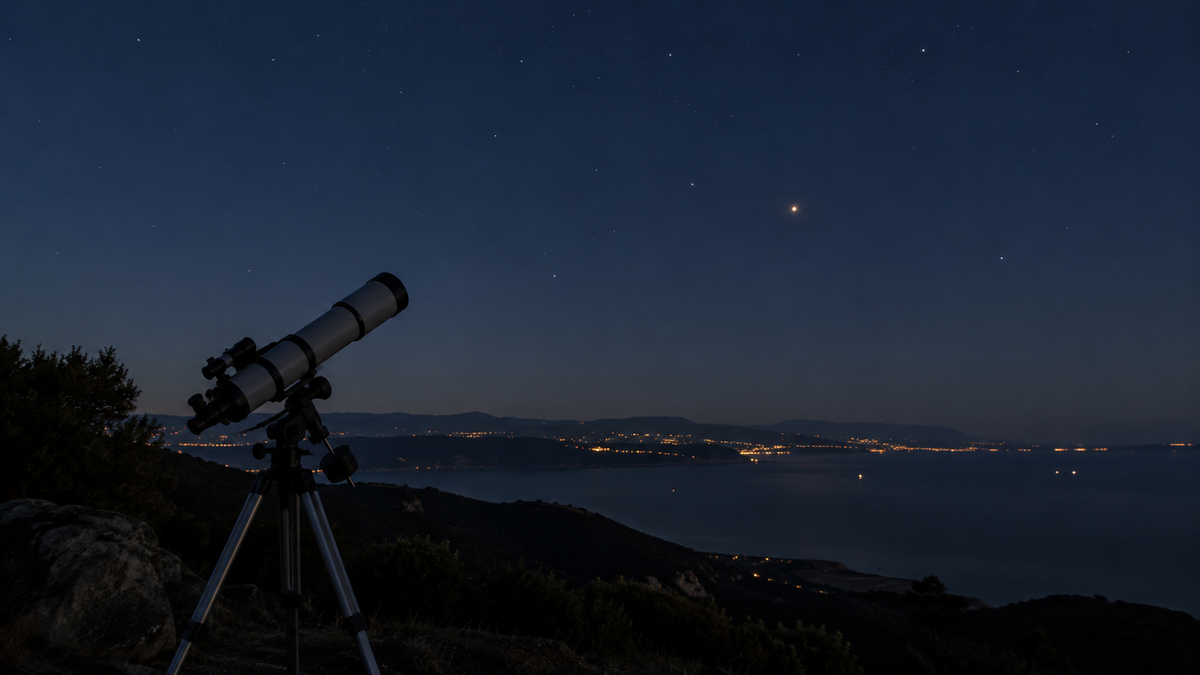
On 4 October 2026, Saturn reaches opposition — one of the best nights of the entire year to see the ringed planet.
Opposition happens when Earth passes between Saturn and the Sun. From our viewpoint, Saturn sits almost directly opposite the Sun in the sky. It rises around sunset, remains visible throughout the night and sets around sunrise.
Saturn at Its Brightest
Around opposition, Saturn is also near its closest approach to Earth for the year, approximately 1.26 billion kilometres away. It will shine at around magnitude 0.3, bright enough to see easily with the naked eye once you know where to look.
To your eyes, Saturn will resemble a bright, steady, slightly golden point of light.
But through even a modest telescope, the experience changes completely.
You should be able to distinguish Saturn's rings — one of the most recognisable sights in the night sky. In October 2026, the rings will be tilted about 7.5° toward us, so they will appear relatively narrow compared with years when the rings are more widely open.
Where & When to Look
Because Saturn is at opposition, there is no tiny viewing window to chase. It will be visible for essentially the whole night, weather permitting.
For all six locations below, the easiest viewing is generally from late evening through around midnight, when Saturn has climbed well above the horizon.
| Location | Recommended Viewing |
|---|---|
| 🇸🇬 Singapore | 4 Oct · 9:00 PM–12:30 AM |
| 🇦🇺 Sydney | 4 Oct · 9:00 PM–12:30 AM |
| 🇮🇳 New Delhi | 4 Oct · 9:00 PM–12:30 AM |
| 🇬🇧 London | 4 Oct · 9:00 PM–12:30 AM |
| 🇺🇸 New York | 4 Oct · 9:00 PM–12:30 AM |
| 🇺🇸 Los Angeles | 4 Oct · 9:00 PM–12:30 AM |
These are practical viewing windows rather than the precise instant of opposition; Saturn remains observable for much of the night from all six locations. At opposition it rises in the east around sunset, reaches its highest part of the sky around the middle of the night, and moves toward the west before sunrise.
From Singapore
Singapore is particularly well placed geometrically because Saturn will be close to the celestial equator in 2026. That means it can climb very high in Singapore's sky, rather than remaining close to the horizon.
Start looking toward the east after nightfall. As the evening progresses, Saturn will rise higher and become easier to identify.
No telescope is needed to see Saturn itself. But if you have access to one, this is the night to bring it out.
Why Opposition Matters
Saturn takes almost 30 Earth years to travel once around the Sun. Earth catches up and passes between Saturn and the Sun roughly every 378 days, creating another opposition.
For a brief period each year, the geometry is almost perfect: Saturn is relatively close, bright, large through a telescope and visible throughout the night.
The planet has always been there.
On this night, we simply have one of our best positions from which to see it.
Look east after sunset. Find the steady golden point. Then, if you have a telescope, look closer.
Some wonders only reveal themselves when you look again.
Share:
27 September 2026 — The Harvest Moon Meets Saturn
12 October 2026 — Mercury at Greatest Eastern Elongation